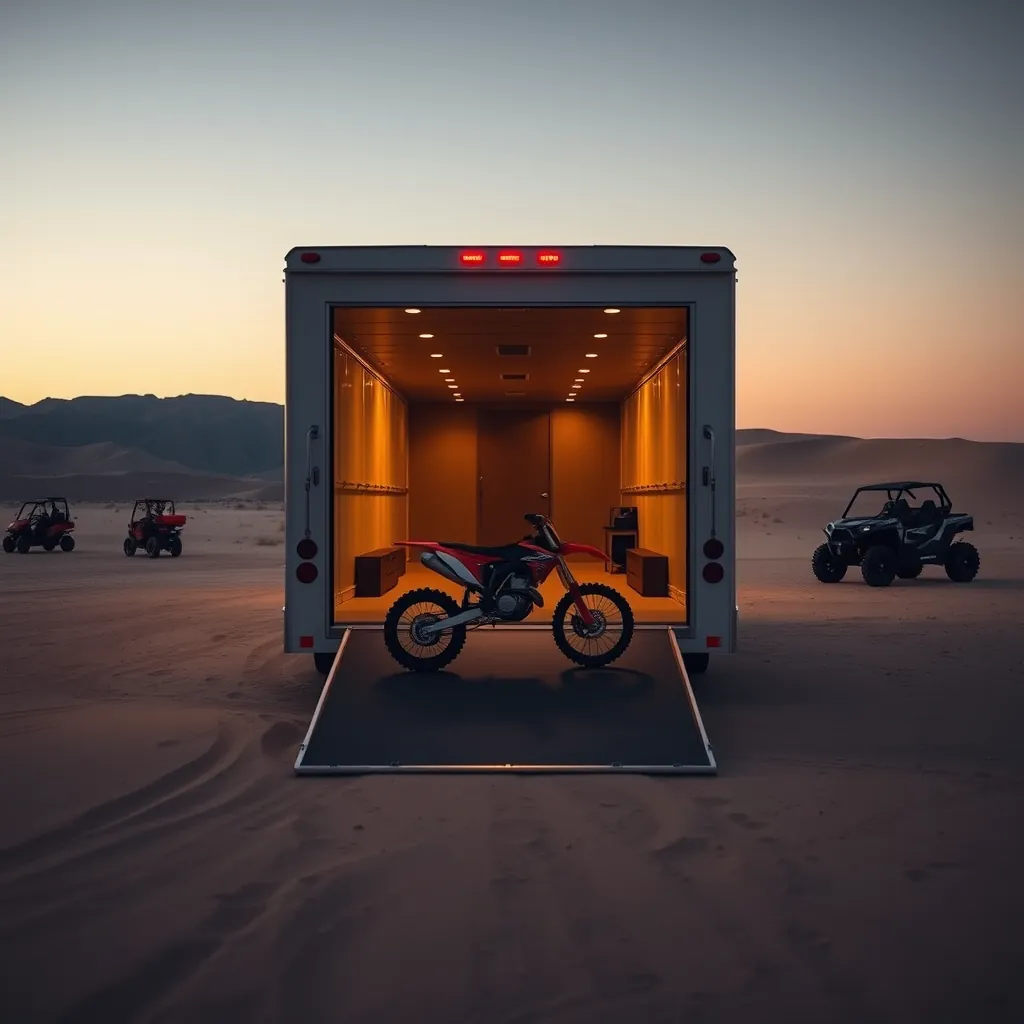
Two Toy Haulers, Same Coverage Types, Different Risk Profiles
Whether you're shopping a fifth wheel toy hauler or a bumper-pull travel trailer, the insurance coverage types are the same: comprehensive, collision, vacation liability, personal property, emergency expense. What differs is the value of the unit, the connection method to the tow vehicle, and how those factors affect your premiums and coverage decisions.
This guide breaks down what's the same, what's different, and what each configuration typically costs to insure.
The Mechanical Difference That Matters for Insurance
Fifth wheels use a gooseneck-style hitch that sits in the bed of a pickup truck, connecting via a kingpin to a fifth wheel receiver. This hitch design distributes weight directly over the truck's rear axle — making for stable towing but requiring a specific tow vehicle configuration (bed-mounted receiver, adequate payload capacity).
Travel trailers (bumper-pull) use a standard ball hitch at the tow vehicle's receiver. The tongue weight loads the rear of the vehicle, but the connection point is behind the axle, creating a different tow dynamic.
Why this matters for insurance: - Fifth wheels are generally more stable towing platforms and have lower sway and separation incident rates - Bumper-pull travel trailers are more susceptible to sway events, particularly at highway speeds or in crosswinds, which can lead to more severe rollover accidents - Both can separate from the tow vehicle, but the consequences and frequency differ
Underwriters factor in towing dynamics and hitch design as part of overall risk. In practice, the bigger driver of insurance cost is unit value rather than hitch type.
Value Comparison: Why Fifth Wheels Cost More to Insure
Fifth wheel toy haulers occupy the premium segment of the toy hauler market. Units from Grand Design Momentum, Heartland Cyclone, Keystone Fuzion, Forest River Vengeance, and DRV Mobile Suite range from $50,000 to $200,000+ for high-end models. These are full-feature units with multiple slides, residential-grade appliances, and substantial garage sections.
Travel trailer toy haulers — Lance Toy Hauler, Forest River Wildcat XX, Keystone Raptor, Coachmen Catalyst — generally run $20,000 to $80,000. Smaller format, lighter weight, less complex mechanically.
Higher unit value directly drives higher insurance premiums. More importantly, it makes total loss replacement coverage more valuable — the difference between ACV and replacement cost is larger on a higher-value unit.
Total Loss Replacement: Twice as Important on a Fifth Wheel
Total loss replacement pays for a brand-new comparable unit if your toy hauler is totaled. Standard policies pay ACV — the depreciated current market value.
Here's why this matters more on a fifth wheel:
An 85,000 fifth wheel depreciates to roughly $65,000 after two years based on typical RV depreciation curves. If it's totaled, ACV pays $65,000. Total loss replacement pays $85,000+ (cost of a new equivalent unit). The gap: $20,000.
A 45,000 travel trailer depreciates to roughly $35,000 after two years. ACV pays $35,000. Total loss replacement pays $45,000. The gap: $10,000.
Both gaps are significant. But on a higher-value fifth wheel, total loss replacement protects more money. Given that it typically adds $150–$300/year to a premium, the math strongly favors paying for it on any unit you'd have trouble replacing without a gap payout.
Standard rule of thumb: Buy total loss replacement on any unit you've purchased within the last three years. After three or four years, the gap between ACV and replacement cost may narrow to the point where it's less compelling.
Premium Comparison: What Each Costs to Insure
Fifth wheel toy haulers:
| Unit Value | Estimated Annual Premium | |------------|------------------------| | $40,000–$60,000 | $400–$650/year | | $60,000–$90,000 | $600–$900/year | | $90,000–$130,000 | $800–$1,200/year | | $130,000+ | $1,000–$1,500+/year |
*Add $150–$300/year for total loss replacement. Add $200–$500/year for full-timer endorsements.*
Travel trailer toy haulers:
| Unit Value | Estimated Annual Premium | |------------|------------------------| | $20,000–$35,000 | $300–$450/year | | $35,000–$55,000 | $400–$600/year | | $55,000–$75,000 | $550–$750/year |
*Add $100–$250/year for total loss replacement.*
These are estimates based on typical programs. Your actual premium depends on your state, storage location, use pattern (seasonal vs. full-time), claims history, and coverage selections.
Vacation Liability: Same for Both
Whether fifth wheel or travel trailer, vacation liability works the same way: when you're set up and leveled at a campground, it provides homeowners-style liability coverage for your campsite. Visitor injuries, trip hazards, accidental property damage. It's included in most RV policies or available as an endorsement.
For both configurations, this is coverage worth having. Campground incidents — a visitor trips on your stabilizer, a windstorm blows your awning into a neighbor's site, a child wanders into your propane equipment — are real liability exposures that standard auto liability doesn't cover.
Emergency Expense Coverage: More Valuable on Extended Trips
If your toy hauler is disabled due to a covered loss far from home, emergency expense coverage pays for alternative lodging and transportation while repairs are arranged. The daily limits (typically $50–$150/day) and total limits (often $750–$3,000) matter more on longer trips.
A weekend trip that goes wrong might be one or two nights in a hotel. A two-week cross-country trip where your toy hauler is destroyed could mean 10+ nights of lodging and transportation while dealing with a total loss claim.
Consider your travel patterns when evaluating this coverage. Extended-trip and full-time users should look for higher daily and total limits.
The Garage Contents Gap: Same Problem for Both
Both fifth wheels and travel trailers have the same garage contents coverage gap: standard personal property limits ($3,000–$5,000) don't cover the ATVs, UTVs, and motorcycles stored in the garage at their actual values.
This problem is equally acute on a $50,000 fifth wheel with a Can-Am UTV in the garage as it is on a $35,000 travel trailer with two dirt bikes. Solve it the same way for both: OHV policies on each vehicle.
Which Is Easier to Insure?
Neither has a systematic underwriting advantage. Both are insurable through the same specialty RV markets.
What affects ease of placement more than fifth wheel vs. travel trailer: - Full-timer status: Full-time use narrows the market somewhat - High-value units ($130K+): Need to confirm program availability at higher limits - Very old units: Older units may face stricter underwriting or valuation requirements - Storage location: Some locations (coastal flood zones, high-crime areas) affect availability
The vast majority of fifth wheel and travel trailer toy haulers are straightforwardly placed through standard RV programs.
Getting Quotes for Both
If you're deciding between a fifth wheel and travel trailer, getting insurance quotes for each helps clarify the cost difference. Bring:
- Year, make, model, and approximate value of the unit(s) you're considering
- How you plan to use it (seasonal, full-time, weekend-only)
- What you plan to haul (make, model, value of ATVs/UTVs/bikes)
- Your state and storage location
We can quote both configurations so you have complete cost information. Call 844-967-5247 or request a quote online.